Monday, July 31, 2006

Gee Willickers
"Town Smokes"
by Pinckney Benedict

With a name like Pinckney Benedict, how can you not be a writer?

Pinckney Benedict. Say it with me, everyone at once, "Pin-ck-ney Ben-a-dict-ttt". Now, wasn't that fun? The moment I heard it, I knew I had to pick up his book. Any book. Whatever! Imagine my convivial motions of gratitude when I found that his first published work was a collection of stories about the South, and not about the easy southern gentrified living associated with stories involving New Orleans ("The Big Easy"), but the back-country south where trailer parks and beer drinking blue collar men (women too) are as much a part of life as the overwhelming sound of crickets at night. Bonus!

These stories deliver. This is Benedict's first collection of short stories (the inside flap says, at the time of publication, he was enrolled in the graduate writing program at the University of Iowa - famous for big names). Even so, his talent is raw and unfettered.

Town Smokes is best when the dialogue isn't forced, which it is, at times. Still, it's pretty hard to write entire stories (which he does) with a country accent and make it believable, so kudos to Benedict for (mostly) succeeding. There are moments that briefly teeter on becoming cliche or too on-the-nose, but Benedict knows, skillfully, when to pull back. His talent really comes through in the suspenseful, devastating story Dog, about a man afraid to pull a dying dog out from underneath his trailer. The title story, too, is a superb coming-of-age allegory that's tender and tough at the same time. A boy struggling to get over the death of his father decides to go into town for some "town smokes", because he's sick of rolling his own tobacco, the way his father did. He realizes he doesn't belong, but that realization brings another, more profound one, and his choice is enlightening and perfect. And the first story in the collection won an award. That means it's good!

The people in these stories come alive with each story, so that by the end you have a whole imagined town, a vignette of the south that's hard to leave because it's so real. It's no escape for the people in these stories, but it's definitely one for me. Benedict is from West Virginia, beautiful country known for its rural ways. I love rural stories, they ignite something inside of me. I'm not sure if that's necessarily a good or bad thing, but I'll take it without too much analysis.

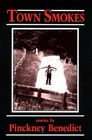
The cover's neat, simple, and conveys the book well. I especially like the saw. I know someone that wants to play a saw. I wonder why she doesn't?

Friday, July 28, 2006

Oh, He's That Dead Guy
"Epitaph of a Small Winner"
by Joaquim Maria Machado de Assis

In the introduction to The Floating Opera, John Barth writes that he was influenced more by Assis than anyone else in the formation and process of writing his first two novels.

By this recommendation alone, I had to pick it up. I'm glad I did.

Epitaph of a Small Winner's narrator is dead and writing, supposedly, from the grave. His method to write this novel postmortem is left out because "its relation would require an excessive amount of space and ... is unnecessary to an understanding of the work." The protagonist of the novel, Cubas, is a deceased writer writing from infinity, and although he has forever, he realizes we do not.

What results is a fantastical novel of ideas. The plot dawdles like a limp leg dragging, but since there isn't much (it's more of a commentary on life, an epitaph(!)), it's not much of a lag. Once the novel enveloped me in its twisted world, in the narrator Braz Cubas's folly-filled head, I found it hard to get out. I laughed a little, and I like books that make me laugh. Even a little.

Braz Cubas isn't quite the hero of the story, there is no real hero. He's just who the story's about. Nevertheless, he is a self-proclaimed pessimist who always gets what he wants. He's a scoundrel and a heathen, but you like him, you can't help but like him. The self-reflexive, metafictional, beyond the grave wit compliments heartily the narrator's ability to make fun of himself and the situations he's in. It's like Vonnegut in South America, only a tad less funny. There are 160 short chapters in about 220 pages, which leads to a lot of short bits of info smattered with a few devoloped instances in the life of the protagonist.

Still, the novel manages to be walloping fun. At the end of a long life he looks back at what he's accomplished, and reaches a rather deep and profound philosophical insight. Questions about the purpose of life linger after the novel's final pages, and, like the best of novels, its lingering is a good feeling, a satisfied one.

And, if for nothing else, this book is a great study of influence on John Barth. Reading Epitaph was a delight for the sheer pleasure of seeing where Barth got certain ideas, where he picked up some of his style, and how he improved upon a form he liked.

Epitaph of a Small Winner is a small winner. It's no strawberry shortcake or ice cream brownie sunday with extra fudge, but it will satisfy your sweet tooth. Barth fans especially should pick this up - it's a sure fire way to know a book is right up your alley before reading a single word.

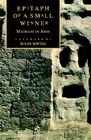
The cover's a little dated, but the weird pictures interspersed throughout the book (although sparingly) more than make up for it.

Friday, July 14, 2006

Stop Whining!
"The Crying of Lot 49"
by Thomas Pynchon

In college, an old philosophy professor took me into the library. He stopped in an aisle between rows and rows of books, pointed, and said, "To read every one of these books, in this aisle alone, would take a lifetime." He was slightly exaggerating, but his point was clear. There's simply too much in this world to see, to do, to read, so you have to make choices. We make our choices based on what other people say, most times. Recommendations from friends, newsletters, authors we like, even, God forbid, the Amazon recommendation page (come on, you know what I mean). And it's not only books, but movies and drawrings and plays and everything else under the sun. We're all critics now, too, of everything, given the fact that we can write reviews and recommend things we like, and it's easier for us to narrow down what we like based on shared interests in someone's profile. But I digress.

I picked up Thomas Pynchon's The Crying of Lot 49 because I had heard it was a classic. Indeed, many refer to it as his "most accessible work." I tried, really hard, to like this book, because paid critics hailed it as an intellectual masterpiece, because I didn't want to proclaim "I don't really like it" and be scorned, because not liking something someone says is smart makes you dumb, right?

It's not the first time, of course. There are films hailed as masterpieces you're supposed to love that are just torture to get through. And just about anyone can make something that makes absolutely no sense that is high art just because it makes no sense. I have presently an image of a gallery showing in New York with rich intellectuals staring at a picture of a bull with no horns riding a man with beautifully rendered clouds in the background, all trying to make sense of the oddity, when one exclaims, "Brilliant, I'll buy it for $100,000!" and suddenly the obscure picture means something.

It was a big joke in film school: want to get attention, just make weird Bunuel-esque short films. People snap to attention like someone shoved a blunt object up their . Anything I enjoy that's obviously mainstream bull I shove off as a "guilty pleasure." But why? Because it makes us look smarter if we like something "intellectual", and denounce something as pure trash that has no inherent linguid value. Will someone please pull me back from my tangent!

The Crying of Lot 49 isn't trash, but I don't really like it. How's that? I will now kindly step aside to avoid being hit by lightning from the critic gods. Thank you (I curtsey). Its language alone is uncompromisingly deliberate, the prose insane and rock-starrish, and, if you do want to read it, at least it's short. It's a book both the product of and waypoint for the times. 60s counterculture is everywhere in this book. Free spiritedness, the underground, lovin', drugs, bands, and stamps.

Oedipa Maas, Lot 49's heroine, finds herself co-executor of her ex-boyfriend's estate, and while carrying out her duty, stumbles upon a conspiracy between the current postal system and an underground postal system known as Tristero. Clues are everywhere (mainly in the form of a muted post horn), and Oedipa becomes obsessed with discovering the identity of the Tristero, only to find that mysteriously everything leads back to her ex-boyfriend's estate, and, most notably, his stamp collection. Meanwhile, her husband Mucho Maas becomes addicted to LSD and estranges himself from their relationship, her psychiatrist Dr. Hilarius goes insane with paranoid delusions that Israelis are out to get him, and a number of other aptly named characters make appearances to mix things up.

Pynchon has a penchant for language, and his novel is a joy in that respect. It's fun to read aloud, and the character names are absurdly apropos (Mike Fallopian, Genghis Cohen, Pierce Inverarity, et al.), but the story is lacking, disjointed, and in the end, disappointing. I get the feeling that Pynchon was trying to flex his intellectual muscles rather than exercise his storytelling skills. It felt like a mish-mash of ideas and titillating fantasies that never went anywhere. Of course, it was a lot of fun in 60s films (see Candy or The Magic Christian by Terry Southern - hilarious and brilliant) but not so much when you devote about several hours to a book.

The cover's really cool, the conspiracy story very intriguing and eerie, but in the end, it's all for naught. Although I didn't like this book, I'm still interested in his other novels (especially Mason & Dixon and Gravity's Rainbow, to see how they stack up. There's never enough time...

Wednesday, June 28, 2006

Writers Read!
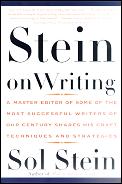
"Stein On Writing"
by Sol Stein

Writers are notorious time wasters. In moments of sheer crisis, we'll find anything to keep us from the unrelenting blank page. Immaculate kitchens, extravagant meals, spotless carpet vacuumed three times a day, these belong to the writer.

That means we'll look for any excuse, and if we're in between delicate words in a carefully crafted sentence and don't want to pick up a scrub brush, we read; books on writing are the biggest indulgence of this nasty habit.

Most books on writing read like memoirs. Said author did this, then did that, worked really hard and got published on a stroke of luck, and though this may be true, you learn nothing about the craft. Stephen King's On Writing is, I hate to say, one of my favorite Stephen King books, because you learn where he was in life when he was writing some of his biggest bestsellers (all of them?), but there's no lesson, only unpractical life stories. Other books are similar. Stein On Writing is different. It directly addresses what you should be thinking about when you are writing. It tackles the writer's job, not the writer's life.

Certain chapters are noticeably lacking in depth and examples. Stein talks about "liposuctioning flab", and would have done well to shave the chapters on "Particularity" and "Guts". Stein shamelessly plugs his own work towards the end of the book, but even so, he offers practical advice and relatable, usable techniques to get your story down on paper. Make your characters interesting by giving them a particularity, he says. His most important lesson is the best learned: as a writer you have to be conscious of your audience, you have to work at manipulating the pages to keep them interested. He suggests ways to keep the tension high and the suspense long, and stresses that creating tension and suspense are keys to a good story. If you want to tell stories but aren't sure how (and never took a creative writing class, like me) you'll find this book especially helpful.

There are few books on writing that offer solid practical advice into the hows and whys of the craft (The Lie That Tells a Truth, Writing In General and the Short Story In Particular), and Stein On Writing gladly joins them on my bookshelf for the next time I'm feel particularly constructive, can't seem to find the right word, and need some inspiration to find it.

The cover's all about writing. No pictures, just words. I like it!

Tuesday, June 20, 2006

I'm a Thingamabrarian!

Dilley dalleying around, I stumbled across this website featured on Blogger's Blogs of Note:

Library Thing

It's self-described as a MySpace or Friendster for books, and it's very cool. You can catalog your library of books. Like MySpace, you're linked to other people based on your books, and it's not a meeting-place like MySpace, it's a social collaboration of sharing ideas and books. Among a thousand more fantastically hip time-wasters, you can find other libraries "eerily similar" to yours, get recommendations, see your library on the internet (with pictures, of course), and even organize your books. But I can't do it justice. Check it out. It's addictive.

My name's "fourteenerus", if you wanna compare.

Saturday, June 17, 2006

Blahbetty Blah Blah
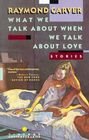
"What We Talk About When We Talk About Love"
by Raymond Carver

As long as the title is, the short stories in this collection are exactly that. Short. Not to say they don't have power. Less is more, right? I have put off reading Raymond Carver's stories for a long time. For some reason or another, he has eluded me, but I could hold out no more. It's a tiny book that will disturb you, hold you, grip you, and leave you, at times, utterly dumbfounded.

Each of the seventeen stories in this collection is about love in some way, and most of them, wait, no, all of them, have negative connotations or involve negative circumstances. The string that ties these stories together are the differing perspectives of love, of relationships in moments of crisis, from seventeen different angles. From the poor choices of one partner in The Calm to a man so fed up he's put all his furniture on the front lawn in Why Don't You Dance?. The title story promises a glimpse into relationships and shows us how shallow and crass we can be, we expect deep discussion about love and its meaning and get an inquisition into one character's loyalty to a former, abusive lover. And my favorite, So Much Water So Close To Home, involves a man whose wife is angry at him to the point of leaving him because he and some friends discovered a corpse at the beginning of a camping trip and decided not to notify the authorities until the trip was over, thinking the corpse wasn't going anywhere and there's no sense ending the trip early if it would all be the same in a few days.

Carver's strength lies in his ability to pose questions. He dangles the truth just out of our sight and never gives it to us, demanding that we decide the relevance. Most of his stories are vignettes of instances, each tableau raising its own questions, hanging there waiting to be answered; until everything turns symbolic and the stories become unique allegories, small metaphors like ink blots that depend on the reader's interpretation, different from person to person.

Carver's collection resonates because it's evocative. It succeeds because each story deftly illuminates a complex world where morals are fuzzy and emotions are unclear. Indeed, what we talk about when we talk about love isn't love most times, but something different entirely, something that hardly makes sense at all. And still we try. Still we try.

Don't judge this one by its cover - it's better than it looks.

Wednesday, June 07, 2006

Guise in Disguise
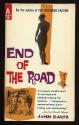
"The End of the Road"
by John Barth

One can imagine Barth at a bar, late one night, chatting lucidly over a beer the relevance of any number of philosophical subjects and then later, accepting a dare. Create a character that has no character. One can imagine it simply because he did.


Jacob Horner is a man whose mood changes like the weather, at a whim, several times a day. Yet he is intelligent beyond belief and is able to grab hold of any side of a debatable topic. Horner, though, is a man with many problems, not the least of which is immobility, that leads him to the care of a doctor who will not disclose his name. The doctore prescribes Horner the only logical thing that will cure his immobility and characterless character: he must become a professor of prescriptive grammar at Wicomoco State College.


There he meets Joe Morgan and his awkward but sometimes graceful wife Rennie Morgan. He begins to take riding lessons with Mrs. Morgan which leads to an eventual slip-up affair one evening that they both regret. Rennie tells Joe, and rather than be angry, he wants to "wrap his hands around the thing," understand it fully, so he sends Rennie to commit the crime again. And eventually she gets pregnant - the father is up in the air. And so Barth touches upon a subject one can only imagine as taboo and controversial beyond belief in 1960: abortion. It is this subject, it's treatment, and the suspense and lively story thus created that save Barth's novel, and save it well.


Meanwhile, Horner has minor relations with a bitter woman named Peggy Rankin (he mentions that he's forced into these situations, otherwise he's asexual), and spars with Mr. Morgan over a variety of topics where Horner's mood and opinion shift from one hodge-podge to the next. Most of the time he says he has no opinion simply because he has too many opinions. Mostly, it is Horner's openness to the possiblity of everything that leads him to become such a chameleon, the most passive central character in fiction I've come across. This is accentuated with the stolid stance of a statue of Laccoon Horner stares at in times of change. The statue never changes, but, depending on the day and Horner's mood at the moment, Laccoon will bear a smile, or be concerned, or be sad. One never knows.


Barth flourishes with humor, and indeed every page is filled with subtle laughs and in-between-the-line jokes, but this book, the self-proclaimed sibling to "The Floating Opera" can't help but fall in the shadow of it's older, wiser, all-around better sister. It's a good read, and it progresses as the story reaches it's climax, but it's nowhere near as insightful nor daring as its counterpart. "The End of the Road" may be just that, but it reads like an exercise at times rather than a well written novel. I'd still recommend the journey, with the preface that the road is at times laborious, but the end of the road should make it worth the ride.


It's cover - hmmm, well, the same as "The Floating Opera." My edition shares these two titles, but I like the separate covers more. They're both interesting enough - I say read them!

Monday, May 15, 2006

A Tryst for Two
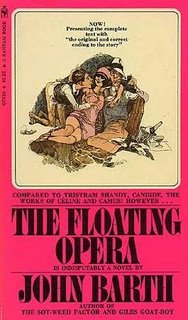
"The Floating Opera"
by John Barth


John Barth says his novels come in pairs, and in keeping with his spirit, I'm rereading his first two novels as a pair. Out loud. It's very insightful listening to the words of someone you so admire, as I do John Barth, because you see the genius of his words and at the same time get that sinking feeling that no matter how hard you try you'll never be as good as that. Plus, several times, it was quite a challenge not to get tongue tied.

The Floating Opera, then, whose counterpart, according to its author, will be the soon featured The End of the Road (the two are sold as a pair under the same cover), is a raucous adventure through a day in the life of one very interesting anti-hero named Todd Andrews. That's right: one day. Barth is obviously attempting a literary tradition trying to pull a novel out of one day, the likes of which Joyce has done in momentous form with Ulysses as well as countless others. The upside is it's fantastic fun. Andrews is witty and clever, he's shifty and reasonable, he's the guy every guy wishes he could be without really ever wishing they could be him. Todd Andrews is a lawyer, he's been a saint and a cynic previously, and on the day in question, he's planning to kill himself.

So suicide in all its controversy (more so I'm sure in 1957) is highlighted gloriously, arguments made for its necessity and rebutted for its inherent paradox (if life has no value, and suicide is thus useful, then death has no value, and suicide is thus useless). Along the way we meet a cast of interesting characters, including the beautiful Jane Mack, wife of best friend Harrison Mack, who Todd has an affair with with both Harrison's knowledge and consent, their daughter Jeannine (who may or may not be Todd's), the Dorchester County Explorer's Club, and many, many more. It touches on everything from war to the law to relationships, and yet, like its narrator, commits to nothing. It's a full boat, The Floating Opera, but it will never sink.

The cover's great, and while it's about the author's beloved Maryland Tidewater area, which he writes magnificently about, it makes me really want to visit the south.

A Life of Abstraction
"The Seven Mysteries of Life"
by Guy Murchie


Ever wonder what it all means?

Guy Murchie did - for twenty some years (more, probably, because he's got more books). And the result of his fruitful ponderings is The Seven Mysteries of Life.

Life, Murchie begins, is only one part of existence, and to understand this, we must step back and take a look at the world from a birds-eye view. As an outsider, we see the intricate workings of the planet and are astounded by many things. Along the way Murchie finds and elaborates almost every conceivable mystery man has ever taken into consideration and turns them into a (most often) one-sided argument. Humans, according to Murchie, are interrelated with kingdoms, even species, evolutionarily and genetically (one and the same I suppose) so that we all are mere thousands of generations apart, given the species or kingdom. Plants behave maliciously as some predators, a flock of birds pictured from above resembles an island, and on and on until there are no delineations between anything and this world is a seed in germination of something larger. Examples abound to support Murchie's conclusions, but examples are not enough because examples do not hold up his argument alone.

The fallacy of the book is its age, and the fact that Murchie takes for granted some conclusions that have yet to be proven or even given credibility. The arguments may rest on faulty precis, but they lends to some interesting conclusions - even if they are falsely achieved. Its ability to ask questions, not answer them, is the strength of the book, and rightfully so, for it is called The Seven Mysteries of Life. So the bulk of his arguments ends up resting on a single card, paper thin, and all is needed is a semi-keen mind to blow it down. Still, the book does what its title suggests best: asks questions. Indeed, it makes connections between the cell of a human body analagous to the human body in relation to the earth, the earth to the galaxy, the galaxy to the universe. Even rocks have a place in the living, breathing, universe, and everything, from cars to plants to insects to humans is just a smaller part of a larger organism which behaves in much the same way (homeostasis-wise) as we humans do.

The best books get you interested in things. They get your mind going. They lead you to new interests and reinvigorate you to pursue old ones. This one has done it many times over for me, from a renewed interest in the microscopic world to finding out who my ancestors are. And even though the argument may be faulty, the conclusions lead to some interesting insights. Truth is a drop in an ocean of uncertainty, and most times imagining the possibilities those uncertainties have is enough to make one wish there never is a concrete answer to the seven, or any, mysteries of life.

This book weighs more than the soul does according to researchers quoted by Guy Murchie.

Monday, April 24, 2006

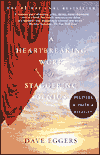
His Name is Dave Eggers
"A Heartbreaking Work of Staggering Genius"
by Dave Eggers

I first heard about Dave Eggers two years ago. His book was big news at the time, but I neglected to read it. He re-entered my memory when I read an article about 826LA, a sister center of 826 Valencia that tutors children on writing fiction and creative non-fiction for free. He founded 826, is an editor of edgy, humorous, and entertaining McSweeney's, and is an amazing writer.

The book has been on my shelf for a year and a half. I picked it up a couple of weeks ago to give it a go, to see what all the hype was, to make my own judgment. Eggers is talented, that's for sure. He can make you laugh or cry or anything in between. His writing is fleeting and enthusiastic and dark and depressing all in one fell swoop. "Heartbreaking Work of Staggering Genius" tells of his struggle to cope with the death of his parents while raising his brother Toph, only 15 years his junior. It's far from a perfect book, but what is? The story is inherently touching; any reader must exude admiration for the painstaking life Eggers has led, the amount of responsibility he took on and the courage to describe it honestly (sometimes humorously) for the world (us readers) to pick apart as I am doing right now. In McSweeney's fashion, Eggers has a preface with parts of the book to skip and a lengthy acknowledgements section outlining themes of the book, disclaimers on sex in the book (one section details how several nude scenes were omitted), and an outline of the amount of money it Eggers made from the book. And while funny, it's a bit trying. And even though he wrote that it's okay to just skip over the preface and acknowledgement section, I can't, because I have to read every word. So it got a bit self-indulgent, a tad annoying, but just when I had the book cocked back ready to throw across the room the story started and I was on this whirlwind rollercoaster of disbelief and failure and brotherhood and love. And it paid off.

The cover's pretty. I like the red curtain pulling back from the sun. Red. Like the world's a show or something.

Wednesday, April 05, 2006

Exciting litblog

While in Oregon, browsing the internet, I've come across a very interesting litblog I've had some time to explore. It's led to a lot of great discoveries.

Good websites are few and far between, and I'm pretty happy to have found one. It isn't often.

Its name is Conversational Reading

Little Book of Wonders
"The Elements of Style" by William Strunk Jr. and E.B. White

This little gem comes with a whopping punch. For anyone looking to speak better, write better, or plain communicate better, this book offers sound advice and helpful examples. Writers will like the chapters on Style and Composition, grammaphiles will enjoy the rest, and everyone will benefit. Strunk started it, and E.B. White (of Charlotte's Web fame) finished it, touched it up, made it a classic. The book is so well written; after I finished one chapter I fell asleep and had a dream of completing a sentence correctly or choosing the right word, just the right word. I'm not saying it was pretty, I'm saying it was effective. Writers of fiction and non-fiction narrative will gain greatly from this book, from rules and advice like use the active voice, be clear, and omit needless words, you'll take a lot from this tiny bible. It's exciting to know this book exists, even more exciting to own it and flip through it whenever I need a sound word of encouragement and advice.

I like the cover. It's elegant in a mainstream, tongue-in-cheek, way.

Monday, April 03, 2006

Make Love Not War
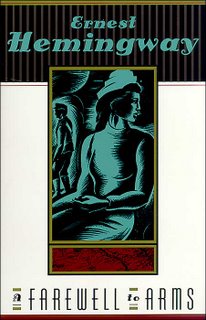
"A Farewell to Arms" by Ernest Hemingway

Hemingway, at a nubile 30, composed this taut, gripping tale about an ambulance driver who falls in love with a nurse in the midst of World War 1 in powerful prose. The thing to love most about Hemingway is the way he tells his stories. Unpretentious to the last, you can read his novels at face value or in between the lines (of course, between the lines is always a far richer experience, and Hemingway is a master of the unsaid), and this book is no different. The novel floats back and forth between a never-ending world war filled with desperation and loads of men who don't want to fight in it and a love story that blossoms in a hospital and blooms across the whole of Europe (including a beautifully rendered Switzerland). It is ultimately a beautiful story about love and loss and death and the inexplicable mystery of war and humans killing each other whether they're on the same side or not (at least sometimes). Hemingway is a master, of course, but his books, and this one is no exception, should be read as any other book. They all have their faults, minimal faults, but faults nevertheless. The important thing is that those faults don't govern the story. Here, of course, they do not, and even though the dialogue is often stiff and forced, the romaticism rings true, the war is depressing, and the story itself is uplifting, tragic, human, and evocative beyond many even half-efforts. It's a book that almost demands a second reading. Knowing the end, everything before that takes on more weight, is given more gusto, and rings with a fair necessity that this, friends, is life.

There are several covers, as there are several editions. And, given this particular cover, I'm glad I didn't judge the book solely by the cover. It, sadly, blows.

The story behind the novel, and others, can be found here.

Friday, March 17, 2006

The Power of Oops
"The Accidental" by Ali Smith

I heard of Ali Smith's new novel, The Accidental, from a newspaper article about the finalists for the Man Booker prize that labeled the book as "experimental". The last experimental novel I read was House of Leaves, and I loved that, so, no cover needed, I checked it out. The story is simple, and a bit misleading. A woman named Amber enters a house without explanation and touches the lives of the four family members occupying it (as a summer getaway) in completely distinct and absolute ways. Eve thinks she's a student her husband is sleeping with and Michael, her husband, thinks she's a friend of Eve's. She wriggles her way into the family, and, due to increasingly blunt honesty, pushes herself out. Yet in the process she completely changes each and every one of the characters.

Smith is a complete wordsmith and her novel isn't so much circular as it is enclosed. The structure is delicate and precise, which agrees with me immensely because I like precise art, art that I can decipher. There are three parts to the novel: the beginning, the middle, and the end. Each has four chapters. The first three begin and end in the middle of a sentence, seemingly disjointed but with purpose, the fourth begins in the middle of a sentence and ends with a period. And a final chapter offers brief, if tangential, perspective. Starting and ending the chapters in the middle of a sentence blends the stories together, makes them seamless, and provides a great metaphor for the overlapping nature of truth as it appears to different people in the same situation. The only word I can think to describe the novel fully is vertiginous. The novel folds in on itself constantly but also is delicately structured so that the beginning and end revolve around neat little poems in the middle.

Satisfyingly, the novel examines the nature of truth, and, with four chapters in each section offering differing perspectives of the days of each of the characters, ultimately asks more questions than it answers. But that's the point, that's the beauty of the novel. At one point, the son, Magnus, who is completely enamored with Amber (he thinks she is an angel sent to save him, and later a teacher, of sorts), and fancies himself as "Hologram Boy" and "Electrostatic Man", alter-ego's he's created in the wake of his teen angst, gets frustrated when Amber questions his assertion that a man named Leibniz invented the equals sign. His proof is that he read it in a textbook or a teacher told him and so it must be true. She asks if anyone checks the teachers, asks if it can possibly be untrue, and makes Magnus question his own knowledge. Later Magnus finds that it wasn't Leibniz that invented the equals sign, it was a man named Robert Recorde.

And so is illustrated the unifying theme of the book: truth. A truth that changes, that has many right answers, that has many different perspectives. A truth that in Ali Smith's book asks many more questions than it answers. truth I can swallow.

The cover's intriguing, and even better after reading the novel.

Columbus, You're Sorta Wrong
The World Is Flat by Thomas L. Friedman

Few discoveries lately have had more weight than Thomas Friedman's shocking discovery blared out as the title of his book. THE WORLD IS FLAT! Both a fantastic guide to the past, and a guidepost for the future, The World Is Flat is a book that should be required reading for anyone hoping for success in the future. The world isn't actually flat, but what Friedman lays out is an argument for the flattening power of globalization. More jobs are outsourced now than ever before, but, contrary to popular opinion, this is better for everyone. Americans and other countries. Most of the jobs outsourced are basic jobs, so the challenge to Americans, to keep jobs, is to find a specialization, to innovate and expand their skill sets. Highlighted are the damaging effects of poor education, minimal stress on the importance of math and science to our youth, and the poor job of the government (and Bush rhetoric) that turned 9/11 into a date of fear rather than one of hope and moving forward. Globalization can be a good thing for everyone. The technology at our fingertips makes everything so much easier, and it's only going to get better, with so many minds from an eclectic mix of places collaborating for the greater good. It's certainly an exciting time to be alive and in the middle of the technological age (especially if you're a techno-gadget gotta have every little thing from Best Buy guy, or gal), but the responsibility lies with us to stay on top of the market, to stress and fund a better education for our youth, or we may find America lapping up the seconds of more ambitious countries like China and India.

The sailboat falling off the side of the world, on the cover, is quite funny, and even if you don't read the book, you can still laugh at the cover.

Thursday, March 02, 2006

He says he will never die
Blood Meridian by Cormac McCarthy

This is the first book I've read by Cormac McCarthy, not the last. One of my favorite novels of the past few years. Dense language, thick plot, all action, minimal dialogue. The novel is a multi-layered, nuanced study of both the savagery of the Wild West and human nature itself. The novel is very mythical, not since The Natural have I read anything so engrossed with sheer power. It centers around "the kid" - a never named, tough runaway who listens to no one but himself. The kid enters into a decades long struggle with life and death and everything in between, mediated and finally mitigated by Judge Holden, one of the most well wrought characters in modern literature. I liked this book so much I started it over as soon as I finished. Every single word in this book is necessary, the violence is so thick, the mood so perfect, the massacres so real, you can practically wring the blood out of it.

And, the cover's cool.

Wednesday, March 01, 2006

See the cat? See the cradle?
Cat's Cradle by Kurt Vonnegut

A hilarious romp. At once cataclysmic, refreshing, sexy, and scathing, this dynamic novel about the end of the world and the search for meaning and ice-nine features a new religion created by a guy that just wanted to see if he could create a new religion (Bokonon and the "Books of Bokonon".) Hero Jonah, as he is named only once, a great reference to "Moby Dick" (thanks Aubrey), seeks out the children of Dr. Felix Hoenniker, creator of the atomic bomb, in search for the elusive ice-nine and material for a book, ends up on the island of San Lorenzo, of which he becomes the President, briefly, falls in love and touches feet with Mona Aamons Monzano, and survives the end of the world. Witty and irreverent, Cat's Cradle is truly for the ages. Published in 1963, relevant today.

Kurt Vonnegut is the modern day Mark Twain.
Oh, and the cover's nice. I like the contrasting lines.