Saturday, March 10, 2007

Thumbs Sideways
Sideways
by Rex Pickett

Hmmmmm.

First of all. The movie's better. It's rare that happens, even rarer that I enjoy saying that. Still, it's true.

Now then, that that's out of the way - Sideways - a fortunately quick read told by a protagonist that really takes some getting used to (if you ever do get used to him) that wanders and meanders to who knows where and ends up just as lost.

I'm sorry, I'll really try to make some sense.

This novel follows two middle-aged men on a week-long wine binge before one of them gets married. Miles, a struggling/failed writer is at wit's end in his personal and professional lives, is supposed to clash comedically with Jack, the fun-loving, charismatic, mildly successful B-actor about to get married. They're best friends, if you didn't already guess that, and they're out for one last hurrah in Santa Ynez wine country. They both drink from morning to midnight, mostly wine, in what seems to be a fictional story set in a very non-fiction world. The restaurants are real, the wineries are real, the hotels are real.

Yet, none of this makes a shred of difference. The characters aren't real, and if they are, I don't care because they're crass and dispicable and unfunny and full of predictable lines. Sure, there are a few moments shining with insight, but they are as rare as the laughs. Jack's recurring injuries that mimic his inner struggle to kill his upcoming marriage was the one saving grace in a novel full poorly plotted and even more poorly executed. I'm just glad it was quick and that they made a movie out of the book that made wine-tasting seem more enjoyable than delinquent.

I can only hope that I don't sound as pretentious and snobby about wine when I do learn about it, because I am trying desperately to learn, and that I can enjoy it without turning my nose up at the next guy.

Wow! That was bad. It actually turned out a lot worse than I thought it would. I guess I really didn't like that book. Eeh!

Maybe I'll have some wine with my whining. Maybe some Merlot.

Sunday, March 04, 2007

Miracle-Gro
"Where the Red Fern Grows"
by Wilson Rawls

I've been on a kick lately of reading books I never got the chance to read. When I told Aubrey I'd never read Where the Red Fern Grows she told me I had to read it, that it was the first book she read and reread zealously as a child. I was intrigued.

But I tread lightly. Aubrey likes books that are sad, her recommendations are books that make one want to cry their weeks away, to wallow in the sadness, to feel the deepest, saddest emotions the earth has afforded us.

And still, I had to read it. I'm glad I did.


Billy saves up money for two years to buy some hunting dogs so he can hunt coons in the foggy river bottoms of Ozark Country, which is quite a feat for any young boy. He finally gets his dogs and trains them with patience and care matching that of the most committed trainers, and breeds two of the best hunting dogs. Billy and his dogs go out night after night, and they form one of the strongest bonds ever illustrated in a book.

This book started slow, and though I was into the ideas of it, I had a hard time getting into it. I stayed patient, and it payed off. About halfway through I was hooked, and at the end I was so devastated yet hopeful that I could see why Aubrey loved this book, why she had read it again and again. This story not only evoked feelings within me I had long since forgotten, it transported me to a time and place I love to go. The south, the Ozarks, the woods, hunting with two loyal dogs in the woods, skirting disaster at every turn with the imagination and invincibility we all feel we have at such a young age.

Where the Red Fern Grows is a timeless classic, worth every page, worth the slow beginning, and definitely worth the miraculous end. I wish I had read this book when I was younger, but then again, I'm kindof glad I didn't. I'm kindof glad Aubrey recommended this book to me, glad she had me pinned that I would love this book. And I'm glad I listened.

Monday, February 05, 2007

He that troubleth his own house Shall
"Inherit the Wind
by Jerome Lawrence and Robert E. Lee

In college, I took a "Law and Literature" class that assigned this book as one of the reading choices. We were assigned six books over the semester, and allowed to skip one of them. I chose The Brothers Karamazov over this one, and opted to weigh myself down with a dense and hard to finish novel over a simple play. I never finished that heavy novel (though I intend to one day re-attempt it, when I have the time), but I did recently plop myself on a chair for a couple hours and breeze through Inherit the Wind.

This play is quite famous, and its subject matter still topic for heated debate. Creation versus Evolution. What is right, what is wrong, and what is worth teaching in the classroom. Sadly enough, the main battle in this play, the debate over whether children should be taught evolution as well as creation, still plagues our classrooms today. Teachers cannot speak of God for fear of reprimand, yet they cannot fairly present Darwin or his ideas either. And who loses?

"He that troubleth his own house shall inherit the wind." That quote begins this play, and provides the thread along which events unfold. The back flap touts this play as the tense battle between two courtroom titans, drama for the ages. There are some great ideas in this play. Ignorance is exposed in its ugly glory, while the playwrights opt for a bittersweet victory in which no one really wins, and the battle, justifiably so, continues past the last page.

I enjoyed most the stance that creation and evolution can live in harmony, the idea of the creation story as a metaphor for evolution rather than literally, that science doesn't always have to disprove faith. And while I personally subscribe to evolution, I sure do enjoy fitting the beauty of seven days into a billion years, where one day holds the big bang, another the dinosaurs, and our lives just a sliver of a second in the time of the universe.

Bloody Awesome!
"Harry Potter and the Half-Blood Prince"
by J.K. Rowling

I'm hoping I can say something new, something other than "I loved it" or "it was awesome" about this book, but I'm not sure I can. The Half-Blood Prince, Rowling's sixth installment in the series of seven about wizards and Hogwarts and, of course, Harry Potter, not only ups the ante, but does so with style, grace, and a whole heap of pitsweat and tears.

This installment follows Harry as he delves into the past of Voldemort, an ex-student at Hogwarts then known as Tom Riddle. Harry comes into his own as a confident, sarcastic, and very brave young man who is getting a handle on the magical history he is a part of, as well as the responsibility it comes with. Also a treat in this book is the amount of time we get to spend with Dumbledore.

Most refreshing is the sense of growth in the characters (and, incidentally, the author's style) as Harry's years at Hogwarts pass. Not only are we witness to a contemporary coming-of-age story, but the solidity of confidence and absolute mastery of storytelling by Rowling.

And yet, Rowling knows when to pull up the reins. The story moves along swiftly, like a bird in full flight, towards that ultimate and inevitable dive back to Earth. The Harry Potter story is not finished, and although I foresee re-reading all seven novels in a few years I, for one, cannot wait for the seventh to hit the shelves.

Tuesday, January 23, 2007

The Order of Greatness
"The Order of the Phoenix"
by Harry Potter

Wow. I mean whoa! I mean holy crap this book is good. When this book came out I was working at a bookstore, and I sat idly by as people stormed the shelves for this book. As I did, I hurumphed and thought to myself, "What's the big deal? Why all the hooplah? It's just a silly little story about for young adults, some toss aside read."

Boy, was I wrong. The Harry Potter series just keeps getting better. Book 5 is absolutely amazing, and what J.K. Rowling has managed to do with these characters is just stunning to watch. Many nights I found myself reading into the wee hours, totally engrossed, entranced, off in the faraway land of Hogwarts dreading the Dark Lord Voldemort's imminent return. I'd end a chapter and come to, relieved that it was only a book, but believing in so much more.

The Harry Potter series is very multi-layered. And, contrary to what I believed a few years ago, it's not just a story for young adults. So much more is going on in these novels. The characters are so real and so alive and everything that's happening, while heightened to a fantastic level, is truthful and insightful to an astonishing degree. The level of detail in these books is jaw-dropping. I am a fan for life. Nothing has been such a joy to read since The Lord of the Rings, and while I have many favorite stories, those that I can come back to time and time again and learn something new about myself and the world with each visit are the most worthwhile. Harry Potter is one of those stories, and I look forward to revisiting it in the very near future.

Monday, January 01, 2007

Beautiful Number
"The Golden Ratio"
by Mario Livio

It's been said to be featured in The Mona Lisa. The dimensions of the Great Pyramid supposedly hold this value. Great symphonies can be described by this one number.

Phi.

1.61803... to infinity. The motherload of irrational numbers. More mysterious than Pi. And this book, The Golden Ratio, explains it all. Its history, how it was discovered, its supposed uses, and false claims to its use in several of the most wondrous monuments and works of art.

I love math. I love numbers. I love the interaction and how they interpret the world so wondrously, and so I love books that explain their presence.

The Golden Ratio was not what I expected it would be. It surpassed my expectations, but for many reasons which may not seem immediately clear. Livio deduces that pretty much all ancient structures and paintings supposedly constructed out of the mysterious Phi are false, that Phi was not discovered, that it's mainly due to the inherent construction that it's number comes up (what he calls number juggling, or making numbers work for you arbitrarily). He basically proves there is no mysterious connection of Da Vinci, the Great Pyramid, Ancient Greece, or most art and music to the Golden Ratio due to unsubstantial evidence. Either the artist or the designer had no access to the Golden Number, or the number's existence is there because of some fancy number juggling.

I respect that. It takes the mysteriousness out of the number. It makes it more believable. And, because it does show up all over nature (in mollusk shells, the space and rotation of tree branches, the shape of galaxies, anything explained by a Fibonnaci sequence, and any type of fractal) even more wondrous.

Livio breaks down myths about this numbers to support its fantastic capabilities. He also gets into some interesting philosophical discussions inspired by this number about whether math is the ultimate "language of the cosmos" or if it is simply an invention of man and so a mediocre tool that is only the tip of the iceberg of what is really going on. It's interesting reading, and really quite insightful.

Math buffs, history buffs, and knowledge mongrels will find this book fascinating. I suggest picking it up if you have a chance. And when you do, ask yourself, what's your favorite number?

Phi's mine.

Do Ants Have Souls?
"The Prophet"
by Kahlil Gibran

The Prophet is one of the ultimate self-help books. It's religion wrapped in philosophy wrapped in how to live and feel about your life. And it's pretty good, so, for the new year, try something different.

Read this.

I was highly skeptical when a friend let me borrow this book to read. I'd heard about this book before, that it's a staple of New Age feelings and a sort of "listen to the Earth" mentality. I imagine dancing in a circle covering myself interpretively with glue. I made a judgment and I was wrong. The book was very insightful.

As a matter of fact, if I had read this book earlier in life, I feel it would have made a much more profound impact on me, but, having passed a particularly impressionistic point in my life, it didn't have as much influence. Another book I read much earlier, The Alchemist, did in its stead. I've often come back to The Alchemist when I needed inspiration or direction or a path to an answer. The Prophet is equally as insightful.

This tiny book revolves around one man's leaving a town (the prophet of the story) where he has resided for some time. Before he leaves, all sorts of townspeople seek his advice on topics ranging from love to loss to work and so on. The Prophet's answers are short and succinct, even at times a little hippy-ish, but they represent just the type of outlook on the world I strive to have. Be happy with what you get, because you won't get anything else. It's important to dream, to strive for something, because that's what we live for.

Pick this book up when you've got a couple of hours. Your life may not change, but your hours certainly will.

A Whole New World
"His Dark Materials"
by Philip Pullman

Early on in The Golden Compass, the first book in His Dark Materials trilogy by Philip Pullman, I became very afraid. It's not that the stories were scary, okay, they were a little, it's that I began to worry about getting obsessed with the ideas presented in the books. That it would consume me, that I would have to learn everything these books talked about, was not something I had time for.

I didn't become obsessed, but I did become a little bit of a geek for a split second. One split second.

His Dark Materials
is a fantasy trilogy filled with magic and wonder and suspence that succeeds because the ideas the books are based on are actual physical phenomena. But that's about the only reason they do succeed. I have to say I was fairly disappointed with the writing, the plot twists, and the storytelling in general. That said, there's a lot going in this trilogy that makes it worthwhile. Specifically, I like the way the stories deal with religion, and how Pullman turns a young adult trilogy of novels (although he refuses to market them as young adult books) into, at times, a philosophical inquiry into the nature of religion, morality, and how the two mesh.

Also interesting were the use of modern day physics to account for religious occurences. Pullman wondrously equates quantum physics with the presence of angels and souls as if they were one. The ideas are solid, it's only too bad the execution isn't as strong.

His Dark Materials is a healthy alternative to fantasy fans looking for something to bide their time before the next Harry Potter book hits the shelves this summer. It's not as magical as Harry Potter, it's not as intoxicating nor is it even as close to good, but it gets the job done. It's definitely worth the time if you're into science and religion and fantasy. If not, don't bother. You'll be wishing some other dark materials on the books.

Wednesday, October 04, 2006

A Whale of A Time
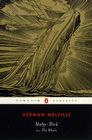
"Moby Dick" by Herman Melville

After all's said and done, I wish I could write that I thoroughly enjoyed Moby Dick. I wish I could say that the book was solid from start to finish, that I couldn't put it down, that I've ran twenty marathons.

But I cannot.

Moby Dick is a massive book about more than just a massive whale (the term "leviathan" says it best, I think). The title refers to a famed white whale with a malformed lower jaw and savagery that equals his pursuers. He's one of the largest sperm whales still alive in the sea, certainly the most ruthless, and, obsession-wise, the hardest to kill. Still, physically, he's not present in the book more than fifty pages. Most of what we see of Moby Dick is through the relentless pursuit of him by Captain Ahab on the famed Pequod.

Ishmael (of "Call me Ishmael" first-line fame) is a deck-hand on the ship and witnesses first hand this voyage of revenge. Shortly after their departure from Nantucket, what seems like a normal whaling voyage turns into a search for a whale that took the recluse Captain Ahab's leg (now filled in with whale-bone ivory). Ahab's a little pissed about their last encounter, he can't think sanely about the whole matter, so he convinces his crew that Moby Dick must be caught. By God, they agree.

And throughout all of this we get to find out every single detail of every single thing they do. What type of rope they use to string harpoons on to throw at the whales, the history of boats, the history and different kinds of whales, so much so that in the end it feels less like fiction and more like animated history.

I like history, I love historical stories, but I easily get lost in details that have no real relivance to the story. Indeed, while I was reading it, I tried to remember the time and place this book was written in, I tried to put myself in the shoes of someone wanting all of this auxiallary knowledge, I tried to imagine, in short, reading the Great American Novel (as Moby Dick started) and I just couldn't do it. I ended up trailing off, thinking about the football game, disinterested in how many feet of rope is generally loosed to account for a leeward sway while the whale runs.

Writing this review now though, after some distance from the novel itself (I finally finished it late last week), I have to take my hat off to Melville for creating a completely engrossing world. At times, I could feel myself sailing on the Pequod, and the moments chasing whales, especially Moby Dick, were so well written my knuckles were white. Spiced in also are what could be considered essays on whaling and religion and philosophy that I found quite interesting, only I wasn't ready for them in a fiction book. I got them nonetheless, and, after some getting used to, was glad for it.

What Melville does best is create allegory with intense realism that gives the story so many more layers. He finds the metaphors in life, and gives them meaning. In the end, that's what makes this a Great American Novel, and though it may be a while, maybe never, until I read this novel again, I will never forget its message of savagery and revenge and the utter desperate tragicness of those wasted emotions that comes so clearly across in the story.

I'd still recommend it, but with two precautions. One, know that there is a lot of extra information, maybe pertinent, maybe not, you get out what you put in. And two, be ready for a committment, because this novel demands it.

Oh, and three, if you see a whale, the proper terminology is always, "There she blows!" because you spot a whale when she breathes, from the water that comes out of her spout.

Ishmael.

Wednesday, August 23, 2006

Physics 401
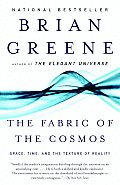
"The Fabric of the Cosmos"
by Brian Greene

The Fabric of the Cosmos is a huge book. It took me about four months to get through, and that's without stopping to really grasp some of the more complicated topics discussed. I picked it up out of innocent curiousity, merely wanting to know more about physics, and I heard this book was accessible and enlightening. So, instead of the oft-discussed A Brief History of Time by Stephen Hawking, I went with this.

Let me first say that I thoroughly enjoyed this book. Brian Greene writes for the layman. His examples of the complicated world of physics involve The Simpsons and X-Files, among other things, making the learning both fun and interesting, and well worth-while. He also lets the reader know when an overly complicated piece is about to be explained and purges any guilt by saying that there's no harm in just skimming over the section. I mean, what's not to like about this guy.

Still, about halfway through, I couldn't help but feel like I was taking a distance learning physics course. Greene gives the entire history of physics, including a thorough treatment of Einstein's theories (with ample Simpsons examples as noted above) and dives into the present and onto the future. Greene has done something quite amazing with this book, he's made complicated physics accessible to the masses while consolidating current research and breakthroughs into one volume, making this book useful to working physicists and rocket scientists and robot designers. That's just a guess.

The distance learning feeling isn't a bad thing though. It's like jumping in the water without getting your feet wet. What I loved most about reading this book is that the topics it covers are exciting. I learned a lot, and even though I'll probably never put any of this knowledge to use, it got the rusty abstract wheels in my head turning. And Greene's a great teacher because he assumes no prior knowledge from his class, so he explains it all, with wonder, which makes it even more dazzling.

Covered in this "course" are the history of phyisics from Newton to Einstein to recent ideas like The Higgs Ocean (basically that air is an entity - which I think makes perfect sense) and electromagnetism to current research on String Theory and Super String Theory and all of their entanglements and excitements. Greene also broaches philosophical subjects, which is inevitable when dealing with the abstract because it is the abstract that much of philosophy encompasses. While I didn't agree with him on most subjects (i.e. teleporting a person, or making a perfect clone, would make the person identical to you down to the last ounce vs. where I think a person cloned would not have the intangible qualities of soul, but would instead have a fresh soul. But I digress because this is obviously a longer discussion better suited for a message board or club meeting, right?) I did find his viewpoint unique and insightful.

The point? If you're of a curious mind, don't want to spend the money for a college course, but want to learn all about physics in one place, if you don't mind not taking tests (wha...?), and if you like to be inspired by words, this book is for you. But be prepared for a committment, and make sure you plan for a vacation when you're done.

As for me, school's out for summer! And as for you, if you pick it up, enjoy!

I like this cover, mostly because of the fluid spiral that I believe is supposed to resemble a string, a tiny plunk length string. But I could be wrong. My mind is mush right now and this book's the last thing on my mind (end of school sigh).

Thursday, August 17, 2006

Crappy Twin
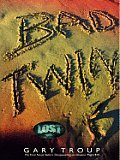
"Bad Twin"
by Gary Troup

I screamed "No!" from page one, but the geek in me, well, the geek in me wanted some answers.

Let's switch universes. We're in Lost reality now, not our world, but the world where Oceanic Flight 815 existed and crashed and one of its passengers was an author, an author of Bad Twin. Now switch back, so we can geek out.

There's a TV show called Lost that just started shooting its third season, and during the break an alternate reality game started called "The Lost Experience". This experience blurs the lines between reality and story world, it crosses over characters in the form of actors. The Lost Experience has encompassed TV commercials, the internet, and now, a book. It's big drawing point is that it's going to explain the numbers (4-8-15-16-23-42), though probably not completely and not without a ton of heavy handed advertising (these people aren't doing this for free, right? they got to get rich!).

In season 2, Hurley's reading a manuscript, called "Bad Twin". He makes mention of the fact that it's really good (don't believe him, his taste is horrible). In an effort to get money from suckers like me (I checked it out from the library, though, so ha!) Hyperion released "Bad Twin" under the pseudonym Gary Troup (A fictional character from the show that was sucked into one of the engines in the pilot episode. He was also a flight attendant named Cindy, whom we haven't seen much of but is going to be part of the third season). "Bad Twin" was one word off from being an apropos title: "Bad Book". It's just as well the real author didn't put their name on it, because it's one of the worst books I've ever read.

Ever.

It's not even worth it to attempt to describe the muddled plot. Just know that none of the dialog is real, all of the descriptions are cliches, and there isn't one instance when you actually believe or are engulfed by the story or the characters. It looks like the people behind this book just threw something together with tangential references to things or people related to the show. In the end, even that was poorly done.

If it helps, anyone interested in The Lost Experience, but not wanting to waste time on this book, here is what is mentioned but never explained: The Hanso Corporation is housed in the Widmore building (which Hurley visits to talk about his money in season 1), Mittlewerk is a man that works for Hanso and is also on the Widmore Corporation's board, there are mentions of the Helios Foundation (people hoping for a new Eden), a Noah's Ark Foundation, the dog's name is Argos, another Greek name, and, per usual, a laundry list of appropriate books are mentioned that may or may not have clues (the book list is so big that nearly anything could).

Other than that, it's a bunch of mumbo jumbo hogwash that goes nowhere and satisfies nothing. With writing like "he got naked to the skin" or "the sugar and caffeine were in a footrace towards his brain" you've got to wonder why and how and over who's dead body did this get out there. Even if it's author was made infamous by a flight that disappeared somewhere between Australia and Los Angeles.

Or did it?

The conspiracy continues, but at least for me, it won't continue in any future books written by dead passengers from Oceanic Flight 815. I've got the geek under control. For now. God Speed.

The cover, like the book, is thrown together. So it too, is good...for me to poop on.

Tuesday, August 15, 2006

No Holes Here
"I Am The Cheese"
by Robert Cormier

I Am the Cheese is one of my longtime favorite books. I just recently bought it and thought, hmm, I think I'd like to share this with Aubrey, the soon-to-be misses.

Whenever I share something I like I get nervous because when I like a book or a film or a piece of art, it becomes a piece of me because I make it my own. Every book I read that I love both takes and leaves profound moments from and in my life. So, as usual, I was nervous, hoping Aubrey would like it.

She did. And, even though it's been a few years since I read this book, it was a hell of a ride, no pun intended. The books starts off with a bang:

I am pedaling furiously and I am on Route 31 in Monument, Massachusetts, on my way to Rutterburg, Vermont, and I'm pedaling furiously because this is an old-fashioned bike...
I've always loved the beginning of this book. The picture of this kid pedaling furiously, bike tires rotating endlessly, off to somewhere. But we're not concerned with that, we're just concerned about the breathing, the hard bike ride ahead, because this kid is going all the way to Vermont from Massachussets, on bike.

It's the all-consuming sense of freedom, of being on a bike on the open road, that attracts me. There's all this danger in the world, you're so vulnerable on a bike, and yet you go, and you feel the wind on your face, and it's all self-sufficient. You are your own momentum. Ahhh.

Without giving too much away, I will say that, for a young adult audience, this book takes some very heavy-handed themes on. Most interesting are the ideas of protection and secrecy, predeterminism vs. free will (or the sense of freedom, being able to make your own choice, vs. the idea that everything you do is being manipulated by someone else, conciously or unconciously), and the awkwardness of young love.

The book flips back and forth between Adam Farmer riding his bike to Rutterburg with a package for his father and an interview, presumably in a psychiatric hospital, between unnamed "T" and unnamed "A". As Adam Farmer makes his way across the state and encounters his own obstacles, more is revealed about the patient "A", and the paths of these parallel stories begin to converge, leading to an inevitable intersection and, ultimately, the revelation of an unthinkable secret.

This book was a pleasure to read. I can't give it any more of a recommendation than to say that Aubrey was hanging on its every word. I caught her reading ahead once (I was reading it aloud to her, which I highly recommend doing, by the way) and pulled the book away so she couldn't see. The suspense had her wide-eyed and breathless. It was great to watch.

I Am the Cheese is a fabulous book. Whoever you are, whereever you may be going, pick it up, I dare you. You'll pee your pants.

The cover is awesome. It's simple, and, like every nail-biting chapter in the book, tells the whole story without giving anything away.

Thursday, August 10, 2006

Hitting the Tylenol PM, Hard
The Sandman part 1
by Neil Gaiman et al.

I have to be honest, I was never hooked on comic books as a kid; I was hooked on the characters. I loved to collect comic book cards, I loved to devour the vital statistics and backstory of every superhero and villain known to man. It was like getting the good stuff without having to make a huge committment. Periodically, my interest bent towards an X-Men or Spider Man comic book, and I was into the Wolverine comic books for a while, but on the whole, it's been a long time.

Until recently. Until The Sandman. It's almost like I've been sleeping all these years. Hmmm.

Sandman is a graphic novel. Graphic novel is a fancy word for adult comic book. It's one of those words we use so we don't sound or feel so childish when we know that, basically, the stigma is that adults don't read comic books. But unlike most of the childish vices we delve into, The Sandman is a comic book that takes you back, that reminds you of the joys of fantastical storytelling. It takes you places, on wings, in style.

Enter the world of Neil Gaiman, writer of The Sandman, where dreams come from an entity whose sister is Death. The Sandman was accidentally summoned by a group of power and life hungry men hoping to capture Death and stay alive forever. Not realizing they had made a mistake, and afraid of upsetting forces they perhaps shouldn't have tampered with, they kept him trapped for years, letting their children inherit their mistakes. The Sandman lost three powerful relics during his enslavement and, when he escaped, came back to a world that hadn't had a good nights rest since he was captured.

Preludes and Nocturnes, the first volume of many, follows The Sandman on a quest to find his lost relics. Along the way, he encounters some characters we've met before (John Constantine, Scarecrow, etc.) and nearly meets up with others more tantallizing (The Justice League of America and Batman, for instance). This alone enriches The Sandman's world, and makes it a pleasure to read the stories.

The artwork is beautifully devastating and the writing gets better with each story. It's neat to see a writer find his voice, try out things that may not have worked but sound really cool conceptually, and finally to see the payoff of what we know is very hard work. While I didn't particularly "buy" all of the stories, I definitely reveled in the fun that they had to offer.

The cover? Come on, it's a comic book cover. It's flippin sweet! Super serial.

Monday, July 31, 2006

Gee Willickers
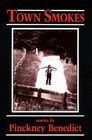
"Town Smokes"
by Pinckney Benedict

With a name like Pinckney Benedict, how can you not be a writer?

Pinckney Benedict. Say it with me, everyone at once, "Pin-ck-ney Ben-a-dict-ttt". Now, wasn't that fun? The moment I heard it, I knew I had to pick up his book. Any book. Whatever! Imagine my convivial motions of gratitude when I found that his first published work was a collection of stories about the South, and not about the easy southern gentrified living associated with stories involving New Orleans ("The Big Easy"), but the back-country south where trailer parks and beer drinking blue collar men (women too) are as much a part of life as the overwhelming sound of crickets at night. Bonus!

These stories deliver. This is Benedict's first collection of short stories (the inside flap says, at the time of publication, he was enrolled in the graduate writing program at the University of Iowa - famous for big names). Even so, his talent is raw and unfettered.

Town Smokes is best when the dialogue isn't forced, which it is, at times. Still, it's pretty hard to write entire stories (which he does) with a country accent and make it believable, so kudos to Benedict for (mostly) succeeding. There are moments that briefly teeter on becoming cliche or too on-the-nose, but Benedict knows, skillfully, when to pull back. His talent really comes through in the suspenseful, devastating story Dog, about a man afraid to pull a dying dog out from underneath his trailer. The title story, too, is a superb coming-of-age allegory that's tender and tough at the same time. A boy struggling to get over the death of his father decides to go into town for some "town smokes", because he's sick of rolling his own tobacco, the way his father did. He realizes he doesn't belong, but that realization brings another, more profound one, and his choice is enlightening and perfect. And the first story in the collection won an award. That means it's good!

The people in these stories come alive with each story, so that by the end you have a whole imagined town, a vignette of the south that's hard to leave because it's so real. It's no escape for the people in these stories, but it's definitely one for me. Benedict is from West Virginia, beautiful country known for its rural ways. I love rural stories, they ignite something inside of me. I'm not sure if that's necessarily a good or bad thing, but I'll take it without too much analysis.

The cover's neat, simple, and conveys the book well. I especially like the saw. I know someone that wants to play a saw. I wonder why she doesn't?

Friday, July 28, 2006

Oh, He's That Dead Guy
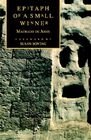
"Epitaph of a Small Winner"
by Joaquim Maria Machado de Assis

In the introduction to The Floating Opera, John Barth writes that he was influenced more by Assis than anyone else in the formation and process of writing his first two novels.

By this recommendation alone, I had to pick it up. I'm glad I did.

Epitaph of a Small Winner's narrator is dead and writing, supposedly, from the grave. His method to write this novel postmortem is left out because "its relation would require an excessive amount of space and ... is unnecessary to an understanding of the work." The protagonist of the novel, Cubas, is a deceased writer writing from infinity, and although he has forever, he realizes we do not.

What results is a fantastical novel of ideas. The plot dawdles like a limp leg dragging, but since there isn't much (it's more of a commentary on life, an epitaph(!)), it's not much of a lag. Once the novel enveloped me in its twisted world, in the narrator Braz Cubas's folly-filled head, I found it hard to get out. I laughed a little, and I like books that make me laugh. Even a little.

Braz Cubas isn't quite the hero of the story, there is no real hero. He's just who the story's about. Nevertheless, he is a self-proclaimed pessimist who always gets what he wants. He's a scoundrel and a heathen, but you like him, you can't help but like him. The self-reflexive, metafictional, beyond the grave wit compliments heartily the narrator's ability to make fun of himself and the situations he's in. It's like Vonnegut in South America, only a tad less funny. There are 160 short chapters in about 220 pages, which leads to a lot of short bits of info smattered with a few devoloped instances in the life of the protagonist.

Still, the novel manages to be walloping fun. At the end of a long life he looks back at what he's accomplished, and reaches a rather deep and profound philosophical insight. Questions about the purpose of life linger after the novel's final pages, and, like the best of novels, its lingering is a good feeling, a satisfied one.

And, if for nothing else, this book is a great study of influence on John Barth. Reading Epitaph was a delight for the sheer pleasure of seeing where Barth got certain ideas, where he picked up some of his style, and how he improved upon a form he liked.

Epitaph of a Small Winner is a small winner. It's no strawberry shortcake or ice cream brownie sunday with extra fudge, but it will satisfy your sweet tooth. Barth fans especially should pick this up - it's a sure fire way to know a book is right up your alley before reading a single word.

The cover's a little dated, but the weird pictures interspersed throughout the book (although sparingly) more than make up for it.

Friday, July 14, 2006

Stop Whining!
"The Crying of Lot 49"
by Thomas Pynchon

In college, an old philosophy professor took me into the library. He stopped in an aisle between rows and rows of books, pointed, and said, "To read every one of these books, in this aisle alone, would take a lifetime." He was slightly exaggerating, but his point was clear. There's simply too much in this world to see, to do, to read, so you have to make choices. We make our choices based on what other people say, most times. Recommendations from friends, newsletters, authors we like, even, God forbid, the Amazon recommendation page (come on, you know what I mean). And it's not only books, but movies and drawrings and plays and everything else under the sun. We're all critics now, too, of everything, given the fact that we can write reviews and recommend things we like, and it's easier for us to narrow down what we like based on shared interests in someone's profile. But I digress.

I picked up Thomas Pynchon's The Crying of Lot 49 because I had heard it was a classic. Indeed, many refer to it as his "most accessible work." I tried, really hard, to like this book, because paid critics hailed it as an intellectual masterpiece, because I didn't want to proclaim "I don't really like it" and be scorned, because not liking something someone says is smart makes you dumb, right?

It's not the first time, of course. There are films hailed as masterpieces you're supposed to love that are just torture to get through. And just about anyone can make something that makes absolutely no sense that is high art just because it makes no sense. I have presently an image of a gallery showing in New York with rich intellectuals staring at a picture of a bull with no horns riding a man with beautifully rendered clouds in the background, all trying to make sense of the oddity, when one exclaims, "Brilliant, I'll buy it for $100,000!" and suddenly the obscure picture means something.

It was a big joke in film school: want to get attention, just make weird Bunuel-esque short films. People snap to attention like someone shoved a blunt object up their . Anything I enjoy that's obviously mainstream bull I shove off as a "guilty pleasure." But why? Because it makes us look smarter if we like something "intellectual", and denounce something as pure trash that has no inherent linguid value. Will someone please pull me back from my tangent!

The Crying of Lot 49 isn't trash, but I don't really like it. How's that? I will now kindly step aside to avoid being hit by lightning from the critic gods. Thank you (I curtsey). Its language alone is uncompromisingly deliberate, the prose insane and rock-starrish, and, if you do want to read it, at least it's short. It's a book both the product of and waypoint for the times. 60s counterculture is everywhere in this book. Free spiritedness, the underground, lovin', drugs, bands, and stamps.

Oedipa Maas, Lot 49's heroine, finds herself co-executor of her ex-boyfriend's estate, and while carrying out her duty, stumbles upon a conspiracy between the current postal system and an underground postal system known as Tristero. Clues are everywhere (mainly in the form of a muted post horn), and Oedipa becomes obsessed with discovering the identity of the Tristero, only to find that mysteriously everything leads back to her ex-boyfriend's estate, and, most notably, his stamp collection. Meanwhile, her husband Mucho Maas becomes addicted to LSD and estranges himself from their relationship, her psychiatrist Dr. Hilarius goes insane with paranoid delusions that Israelis are out to get him, and a number of other aptly named characters make appearances to mix things up.

Pynchon has a penchant for language, and his novel is a joy in that respect. It's fun to read aloud, and the character names are absurdly apropos (Mike Fallopian, Genghis Cohen, Pierce Inverarity, et al.), but the story is lacking, disjointed, and in the end, disappointing. I get the feeling that Pynchon was trying to flex his intellectual muscles rather than exercise his storytelling skills. It felt like a mish-mash of ideas and titillating fantasies that never went anywhere. Of course, it was a lot of fun in 60s films (see Candy or The Magic Christian by Terry Southern - hilarious and brilliant) but not so much when you devote about several hours to a book.

The cover's really cool, the conspiracy story very intriguing and eerie, but in the end, it's all for naught. Although I didn't like this book, I'm still interested in his other novels (especially Mason & Dixon and Gravity's Rainbow, to see how they stack up. There's never enough time...

Wednesday, June 28, 2006

Writers Read!
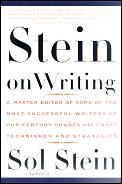
"Stein On Writing"
by Sol Stein

Writers are notorious time wasters. In moments of sheer crisis, we'll find anything to keep us from the unrelenting blank page. Immaculate kitchens, extravagant meals, spotless carpet vacuumed three times a day, these belong to the writer.

That means we'll look for any excuse, and if we're in between delicate words in a carefully crafted sentence and don't want to pick up a scrub brush, we read; books on writing are the biggest indulgence of this nasty habit.

Most books on writing read like memoirs. Said author did this, then did that, worked really hard and got published on a stroke of luck, and though this may be true, you learn nothing about the craft. Stephen King's On Writing is, I hate to say, one of my favorite Stephen King books, because you learn where he was in life when he was writing some of his biggest bestsellers (all of them?), but there's no lesson, only unpractical life stories. Other books are similar. Stein On Writing is different. It directly addresses what you should be thinking about when you are writing. It tackles the writer's job, not the writer's life.

Certain chapters are noticeably lacking in depth and examples. Stein talks about "liposuctioning flab", and would have done well to shave the chapters on "Particularity" and "Guts". Stein shamelessly plugs his own work towards the end of the book, but even so, he offers practical advice and relatable, usable techniques to get your story down on paper. Make your characters interesting by giving them a particularity, he says. His most important lesson is the best learned: as a writer you have to be conscious of your audience, you have to work at manipulating the pages to keep them interested. He suggests ways to keep the tension high and the suspense long, and stresses that creating tension and suspense are keys to a good story. If you want to tell stories but aren't sure how (and never took a creative writing class, like me) you'll find this book especially helpful.

There are few books on writing that offer solid practical advice into the hows and whys of the craft (The Lie That Tells a Truth, Writing In General and the Short Story In Particular), and Stein On Writing gladly joins them on my bookshelf for the next time I'm feel particularly constructive, can't seem to find the right word, and need some inspiration to find it.

The cover's all about writing. No pictures, just words. I like it!

Tuesday, June 20, 2006

I'm a Thingamabrarian!

Dilley dalleying around, I stumbled across this website featured on Blogger's Blogs of Note:

Library Thing

It's self-described as a MySpace or Friendster for books, and it's very cool. You can catalog your library of books. Like MySpace, you're linked to other people based on your books, and it's not a meeting-place like MySpace, it's a social collaboration of sharing ideas and books. Among a thousand more fantastically hip time-wasters, you can find other libraries "eerily similar" to yours, get recommendations, see your library on the internet (with pictures, of course), and even organize your books. But I can't do it justice. Check it out. It's addictive.

My name's "fourteenerus", if you wanna compare.

Saturday, June 17, 2006

Blahbetty Blah Blah
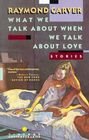
"What We Talk About When We Talk About Love"
by Raymond Carver

As long as the title is, the short stories in this collection are exactly that. Short. Not to say they don't have power. Less is more, right? I have put off reading Raymond Carver's stories for a long time. For some reason or another, he has eluded me, but I could hold out no more. It's a tiny book that will disturb you, hold you, grip you, and leave you, at times, utterly dumbfounded.

Each of the seventeen stories in this collection is about love in some way, and most of them, wait, no, all of them, have negative connotations or involve negative circumstances. The string that ties these stories together are the differing perspectives of love, of relationships in moments of crisis, from seventeen different angles. From the poor choices of one partner in The Calm to a man so fed up he's put all his furniture on the front lawn in Why Don't You Dance?. The title story promises a glimpse into relationships and shows us how shallow and crass we can be, we expect deep discussion about love and its meaning and get an inquisition into one character's loyalty to a former, abusive lover. And my favorite, So Much Water So Close To Home, involves a man whose wife is angry at him to the point of leaving him because he and some friends discovered a corpse at the beginning of a camping trip and decided not to notify the authorities until the trip was over, thinking the corpse wasn't going anywhere and there's no sense ending the trip early if it would all be the same in a few days.

Carver's strength lies in his ability to pose questions. He dangles the truth just out of our sight and never gives it to us, demanding that we decide the relevance. Most of his stories are vignettes of instances, each tableau raising its own questions, hanging there waiting to be answered; until everything turns symbolic and the stories become unique allegories, small metaphors like ink blots that depend on the reader's interpretation, different from person to person.

Carver's collection resonates because it's evocative. It succeeds because each story deftly illuminates a complex world where morals are fuzzy and emotions are unclear. Indeed, what we talk about when we talk about love isn't love most times, but something different entirely, something that hardly makes sense at all. And still we try. Still we try.

Don't judge this one by its cover - it's better than it looks.

Wednesday, June 07, 2006

Guise in Disguise
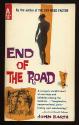
"The End of the Road"
by John Barth

One can imagine Barth at a bar, late one night, chatting lucidly over a beer the relevance of any number of philosophical subjects and then later, accepting a dare. Create a character that has no character. One can imagine it simply because he did.


Jacob Horner is a man whose mood changes like the weather, at a whim, several times a day. Yet he is intelligent beyond belief and is able to grab hold of any side of a debatable topic. Horner, though, is a man with many problems, not the least of which is immobility, that leads him to the care of a doctor who will not disclose his name. The doctore prescribes Horner the only logical thing that will cure his immobility and characterless character: he must become a professor of prescriptive grammar at Wicomoco State College.


There he meets Joe Morgan and his awkward but sometimes graceful wife Rennie Morgan. He begins to take riding lessons with Mrs. Morgan which leads to an eventual slip-up affair one evening that they both regret. Rennie tells Joe, and rather than be angry, he wants to "wrap his hands around the thing," understand it fully, so he sends Rennie to commit the crime again. And eventually she gets pregnant - the father is up in the air. And so Barth touches upon a subject one can only imagine as taboo and controversial beyond belief in 1960: abortion. It is this subject, it's treatment, and the suspense and lively story thus created that save Barth's novel, and save it well.


Meanwhile, Horner has minor relations with a bitter woman named Peggy Rankin (he mentions that he's forced into these situations, otherwise he's asexual), and spars with Mr. Morgan over a variety of topics where Horner's mood and opinion shift from one hodge-podge to the next. Most of the time he says he has no opinion simply because he has too many opinions. Mostly, it is Horner's openness to the possiblity of everything that leads him to become such a chameleon, the most passive central character in fiction I've come across. This is accentuated with the stolid stance of a statue of Laccoon Horner stares at in times of change. The statue never changes, but, depending on the day and Horner's mood at the moment, Laccoon will bear a smile, or be concerned, or be sad. One never knows.


Barth flourishes with humor, and indeed every page is filled with subtle laughs and in-between-the-line jokes, but this book, the self-proclaimed sibling to "The Floating Opera" can't help but fall in the shadow of it's older, wiser, all-around better sister. It's a good read, and it progresses as the story reaches it's climax, but it's nowhere near as insightful nor daring as its counterpart. "The End of the Road" may be just that, but it reads like an exercise at times rather than a well written novel. I'd still recommend the journey, with the preface that the road is at times laborious, but the end of the road should make it worth the ride.


It's cover - hmmm, well, the same as "The Floating Opera." My edition shares these two titles, but I like the separate covers more. They're both interesting enough - I say read them!