Monday, April 24, 2006

His Name is Dave Eggers
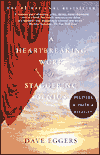
"A Heartbreaking Work of Staggering Genius"
by Dave Eggers

I first heard about Dave Eggers two years ago. His book was big news at the time, but I neglected to read it. He re-entered my memory when I read an article about 826LA, a sister center of 826 Valencia that tutors children on writing fiction and creative non-fiction for free. He founded 826, is an editor of edgy, humorous, and entertaining McSweeney's, and is an amazing writer.

The book has been on my shelf for a year and a half. I picked it up a couple of weeks ago to give it a go, to see what all the hype was, to make my own judgment. Eggers is talented, that's for sure. He can make you laugh or cry or anything in between. His writing is fleeting and enthusiastic and dark and depressing all in one fell swoop. "Heartbreaking Work of Staggering Genius" tells of his struggle to cope with the death of his parents while raising his brother Toph, only 15 years his junior. It's far from a perfect book, but what is? The story is inherently touching; any reader must exude admiration for the painstaking life Eggers has led, the amount of responsibility he took on and the courage to describe it honestly (sometimes humorously) for the world (us readers) to pick apart as I am doing right now. In McSweeney's fashion, Eggers has a preface with parts of the book to skip and a lengthy acknowledgements section outlining themes of the book, disclaimers on sex in the book (one section details how several nude scenes were omitted), and an outline of the amount of money it Eggers made from the book. And while funny, it's a bit trying. And even though he wrote that it's okay to just skip over the preface and acknowledgement section, I can't, because I have to read every word. So it got a bit self-indulgent, a tad annoying, but just when I had the book cocked back ready to throw across the room the story started and I was on this whirlwind rollercoaster of disbelief and failure and brotherhood and love. And it paid off.

The cover's pretty. I like the red curtain pulling back from the sun. Red. Like the world's a show or something.

Wednesday, April 05, 2006

Exciting litblog

While in Oregon, browsing the internet, I've come across a very interesting litblog I've had some time to explore. It's led to a lot of great discoveries.

Good websites are few and far between, and I'm pretty happy to have found one. It isn't often.

Its name is Conversational Reading

Little Book of Wonders
"The Elements of Style" by William Strunk Jr. and E.B. White

This little gem comes with a whopping punch. For anyone looking to speak better, write better, or plain communicate better, this book offers sound advice and helpful examples. Writers will like the chapters on Style and Composition, grammaphiles will enjoy the rest, and everyone will benefit. Strunk started it, and E.B. White (of Charlotte's Web fame) finished it, touched it up, made it a classic. The book is so well written; after I finished one chapter I fell asleep and had a dream of completing a sentence correctly or choosing the right word, just the right word. I'm not saying it was pretty, I'm saying it was effective. Writers of fiction and non-fiction narrative will gain greatly from this book, from rules and advice like use the active voice, be clear, and omit needless words, you'll take a lot from this tiny bible. It's exciting to know this book exists, even more exciting to own it and flip through it whenever I need a sound word of encouragement and advice.

I like the cover. It's elegant in a mainstream, tongue-in-cheek, way.

Monday, April 03, 2006

Make Love Not War
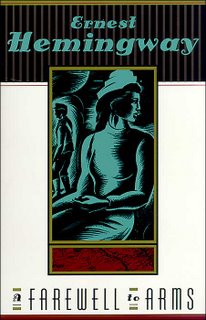
"A Farewell to Arms" by Ernest Hemingway

Hemingway, at a nubile 30, composed this taut, gripping tale about an ambulance driver who falls in love with a nurse in the midst of World War 1 in powerful prose. The thing to love most about Hemingway is the way he tells his stories. Unpretentious to the last, you can read his novels at face value or in between the lines (of course, between the lines is always a far richer experience, and Hemingway is a master of the unsaid), and this book is no different. The novel floats back and forth between a never-ending world war filled with desperation and loads of men who don't want to fight in it and a love story that blossoms in a hospital and blooms across the whole of Europe (including a beautifully rendered Switzerland). It is ultimately a beautiful story about love and loss and death and the inexplicable mystery of war and humans killing each other whether they're on the same side or not (at least sometimes). Hemingway is a master, of course, but his books, and this one is no exception, should be read as any other book. They all have their faults, minimal faults, but faults nevertheless. The important thing is that those faults don't govern the story. Here, of course, they do not, and even though the dialogue is often stiff and forced, the romaticism rings true, the war is depressing, and the story itself is uplifting, tragic, human, and evocative beyond many even half-efforts. It's a book that almost demands a second reading. Knowing the end, everything before that takes on more weight, is given more gusto, and rings with a fair necessity that this, friends, is life.

There are several covers, as there are several editions. And, given this particular cover, I'm glad I didn't judge the book solely by the cover. It, sadly, blows.

The story behind the novel, and others, can be found here.

Friday, March 17, 2006

The Power of Oops
"The Accidental" by Ali Smith

I heard of Ali Smith's new novel, The Accidental, from a newspaper article about the finalists for the Man Booker prize that labeled the book as "experimental". The last experimental novel I read was House of Leaves, and I loved that, so, no cover needed, I checked it out. The story is simple, and a bit misleading. A woman named Amber enters a house without explanation and touches the lives of the four family members occupying it (as a summer getaway) in completely distinct and absolute ways. Eve thinks she's a student her husband is sleeping with and Michael, her husband, thinks she's a friend of Eve's. She wriggles her way into the family, and, due to increasingly blunt honesty, pushes herself out. Yet in the process she completely changes each and every one of the characters.

Smith is a complete wordsmith and her novel isn't so much circular as it is enclosed. The structure is delicate and precise, which agrees with me immensely because I like precise art, art that I can decipher. There are three parts to the novel: the beginning, the middle, and the end. Each has four chapters. The first three begin and end in the middle of a sentence, seemingly disjointed but with purpose, the fourth begins in the middle of a sentence and ends with a period. And a final chapter offers brief, if tangential, perspective. Starting and ending the chapters in the middle of a sentence blends the stories together, makes them seamless, and provides a great metaphor for the overlapping nature of truth as it appears to different people in the same situation. The only word I can think to describe the novel fully is vertiginous. The novel folds in on itself constantly but also is delicately structured so that the beginning and end revolve around neat little poems in the middle.

Satisfyingly, the novel examines the nature of truth, and, with four chapters in each section offering differing perspectives of the days of each of the characters, ultimately asks more questions than it answers. But that's the point, that's the beauty of the novel. At one point, the son, Magnus, who is completely enamored with Amber (he thinks she is an angel sent to save him, and later a teacher, of sorts), and fancies himself as "Hologram Boy" and "Electrostatic Man", alter-ego's he's created in the wake of his teen angst, gets frustrated when Amber questions his assertion that a man named Leibniz invented the equals sign. His proof is that he read it in a textbook or a teacher told him and so it must be true. She asks if anyone checks the teachers, asks if it can possibly be untrue, and makes Magnus question his own knowledge. Later Magnus finds that it wasn't Leibniz that invented the equals sign, it was a man named Robert Recorde.

And so is illustrated the unifying theme of the book: truth. A truth that changes, that has many right answers, that has many different perspectives. A truth that in Ali Smith's book asks many more questions than it answers. truth I can swallow.

The cover's intriguing, and even better after reading the novel.

Columbus, You're Sorta Wrong
The World Is Flat by Thomas L. Friedman

Few discoveries lately have had more weight than Thomas Friedman's shocking discovery blared out as the title of his book. THE WORLD IS FLAT! Both a fantastic guide to the past, and a guidepost for the future, The World Is Flat is a book that should be required reading for anyone hoping for success in the future. The world isn't actually flat, but what Friedman lays out is an argument for the flattening power of globalization. More jobs are outsourced now than ever before, but, contrary to popular opinion, this is better for everyone. Americans and other countries. Most of the jobs outsourced are basic jobs, so the challenge to Americans, to keep jobs, is to find a specialization, to innovate and expand their skill sets. Highlighted are the damaging effects of poor education, minimal stress on the importance of math and science to our youth, and the poor job of the government (and Bush rhetoric) that turned 9/11 into a date of fear rather than one of hope and moving forward. Globalization can be a good thing for everyone. The technology at our fingertips makes everything so much easier, and it's only going to get better, with so many minds from an eclectic mix of places collaborating for the greater good. It's certainly an exciting time to be alive and in the middle of the technological age (especially if you're a techno-gadget gotta have every little thing from Best Buy guy, or gal), but the responsibility lies with us to stay on top of the market, to stress and fund a better education for our youth, or we may find America lapping up the seconds of more ambitious countries like China and India.

The sailboat falling off the side of the world, on the cover, is quite funny, and even if you don't read the book, you can still laugh at the cover.

Thursday, March 02, 2006

He says he will never die
Blood Meridian by Cormac McCarthy

This is the first book I've read by Cormac McCarthy, not the last. One of my favorite novels of the past few years. Dense language, thick plot, all action, minimal dialogue. The novel is a multi-layered, nuanced study of both the savagery of the Wild West and human nature itself. The novel is very mythical, not since The Natural have I read anything so engrossed with sheer power. It centers around "the kid" - a never named, tough runaway who listens to no one but himself. The kid enters into a decades long struggle with life and death and everything in between, mediated and finally mitigated by Judge Holden, one of the most well wrought characters in modern literature. I liked this book so much I started it over as soon as I finished. Every single word in this book is necessary, the violence is so thick, the mood so perfect, the massacres so real, you can practically wring the blood out of it.

And, the cover's cool.

Wednesday, March 01, 2006

See the cat? See the cradle?
Cat's Cradle by Kurt Vonnegut

A hilarious romp. At once cataclysmic, refreshing, sexy, and scathing, this dynamic novel about the end of the world and the search for meaning and ice-nine features a new religion created by a guy that just wanted to see if he could create a new religion (Bokonon and the "Books of Bokonon".) Hero Jonah, as he is named only once, a great reference to "Moby Dick" (thanks Aubrey), seeks out the children of Dr. Felix Hoenniker, creator of the atomic bomb, in search for the elusive ice-nine and material for a book, ends up on the island of San Lorenzo, of which he becomes the President, briefly, falls in love and touches feet with Mona Aamons Monzano, and survives the end of the world. Witty and irreverent, Cat's Cradle is truly for the ages. Published in 1963, relevant today.

Kurt Vonnegut is the modern day Mark Twain.
Oh, and the cover's nice. I like the contrasting lines.